

In this article, Index Agency’s Ads Performance Director, Ghaith Jelassi, explains how Index can help you launch your first ChatGPT Ads campaigns in Canada.
Last week I sat with a Montreal e-commerce founder who runs about $4M a year in revenue, mostly through Google Shopping and Meta. He asked me a question I’ve been getting a lot lately: “Is ChatGPT Ads real, or is it another shiny object?”
Here’s my answer. It’s real. It’s earlier than most realize. And the Canadian brands who set up tracking right now (not next year, not when their competitors do) will own a measurement advantage that won’t be available later. That’s not me hyping a trend. That’s me looking at how Meta Ads played out in 2014 and Google Shopping played out in 2010. The pattern repeats.

The stakes: why this matters now, not later
ChatGPT hit 800 million weekly active users in October 2025. By February 2026, that number passed 900 million. For context, that’s roughly 10% of the adult population on Earth using one product, every week, to ask questions they used to type into Google.
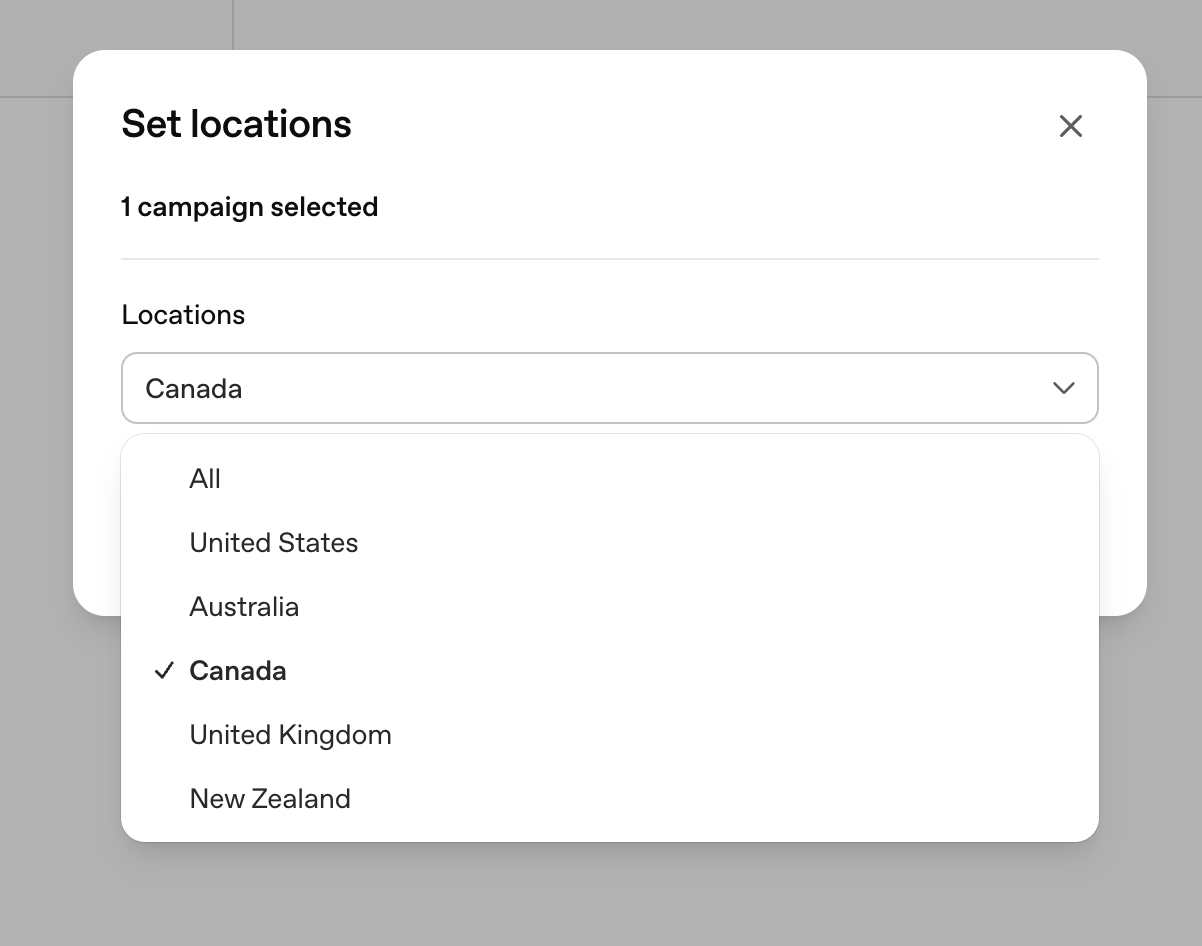
OpenAI flipped on its self-serve Ads Manager for US advertisers on May 5, 2026, with CPC bidding, a Conversions API, and a pixel-based measurement system called OAIQ. The Canadian rollout hasn’t been formally announced yet, but a few agencies gained early access to the advertising platform. And the official Canada opening is a matter of months, not years.
The window where you can run ChatGPT Ads with relatively low competition, cheap CPCs, and audiences who’ve never seen a ChatGPT ad before: that window is open right now. It will close. It always closes.
What ChatGPT Ads actually is, in plain terms
When a user asks ChatGPT something with commercial intent (“best running shoes for flat feet,” “what’s a good gift for a 10-year-old who likes Lego,” “where can I find a Montreal-based bookkeeper for my small business”), ChatGPT can now return a clearly labeled sponsored result alongside its normal answer.
The ad isn’t injected into the AI’s response text. It sits as a separate, visually distinct unit. Users see a “Sponsored” tag. They can click through to your site like any other ad.
The thing that makes this different from Google or Meta is the trigger. Google ads fire on keywords. Meta ads fire on behavior and interests. ChatGPT ads fire on conversation context: what the user is actually trying to accomplish in that moment. Someone asking ChatGPT “how do I plan a 7-day trip to Quebec with two kids” is mid-decision. Not browsing. Not scrolling. Deciding.

That’s a completely different intent profile than a Facebook user thumbing through reels. It’s closer to high-funnel Google Search, but with longer context windows and the ability for the AI to understand nuance that keyword bidding never could.
CPC bidding starts around $3 to $5 per click as a recommended max, per OpenAI’s own published guidance. That’s expensive compared to Meta, cheaper than competitive Google Search categories. The real question isn’t CPC: it’s whether you can track what happens after the click.
The measurement problem is where 80% of brands will fail
Here’s what I keep telling Canadian clients: the ad creative is the easy part. Anyone with a copywriter and a designer can make a decent ChatGPT ad. The hard part (the part that decides whether you’ll keep spending money on this channel or quietly turn it off in 90 days) is the pixel.
OpenAI’s OAIQ pixel works similarly to the Meta pixel or Google’s gtag. You embed it on your site. When a user clicks an ad and lands on your domain, the pixel sets a first-party cookie called __oppref with a 30-day attribution window. It then sends event data (page views, add-to-carts, checkout starts, purchases) back to OpenAI so the platform can attribute conversions and improve its targeting.

Simple in theory. A mess in practice.
I’ve seen brands burn through $10K in Meta budget because their pixel was firing the wrong product IDs. I’ve audited Google Ads accounts where the conversion tag was double-counting because someone put GTM and direct gtag on the same site. The same will happen with OAIQ, except this time, fewer agencies will have the experience to catch it, because the platform is new.
If your pixel fires items_added on every mini-cart refresh instead of only on actual add-to-cart events, your CPA looks great in the dashboard and terrible in your bank account. If checkout_started fires twice because your theme renders the checkout shortcode in two places, OpenAI’s bidding algorithm thinks every checkout starter is worth double, and it bids you into oblivion.
These aren’t hypothetical bugs. These are the two specific bugs we, Index Agency, hit and fixed while building our own WooCommerce-to-OpenAI Ads integration. Which brings me to the next point.
What we built at Index Agency, and why it matters for our clients
About two weeks after OpenAI opened the pixel beta, we shipped a proprietary WordPress plugin that connects WooCommerce stores to the OpenAI Ads pixel. It sends three events: add-to-carts, checkout starts, and completed orders.
I’m not bringing it up to sell you the plugin (it’s for our clients, not the open market). I’m bringing it up because the existence of that plugin is the whole reason an Index Agency client can run ChatGPT Ads cleanly on day one while their competitors spend three months figuring out why their conversions aren’t tracking.
The plugin handles the parts most brands trip over:
- Real
items_addedevents fired on actual cart additions, not on every AJAX cart refresh - Single-fire
checkout_startedeven when themes render the checkout block in multiple places - Proper minor-unit conversion for CAD ($12.99 becomes 1299 cents), and correct handling for zero-decimal currencies (JPY) and three-decimal currencies (TND, KWD) for clients selling internationally
- A choice between direct pixel installation and Google Tag Manager mode, so we don’t break a client’s existing GTM setup
- Order-level deduplication so a customer refreshing their thank-you page doesn’t fire a second purchase event and inflate your reported revenue
The point isn’t the technical detail. The point is this: most Canadian agencies offering ChatGPT Ads will either (a) install the OAIQ pixel manually and pray it fires correctly, or (b) tell you to wait six months until “the platform matures.” We did the engineering work upfront so our clients don’t lose budget to broken tracking.
Who should test ChatGPT Ads in 2026, and who should wait
Be a tester if:
- You’re an e-commerce brand with a clear AOV above $50 and decent margins (under $20 AOV gets crushed by $3 to $5 CPCs)
- You sell something people research before buying: supplements, furniture, B2B SaaS, services, considered-purchase apparel. ChatGPT users skew toward research queries
- You already have working Google Ads or Meta campaigns and have a baseline CAC you can compare against
- You’re willing to commit $2K to $5K per month in test budget for at least 60 days. Less than that and you won’t get statistical signal
Hold off if:
- You’re a hyper-impulse product (single-flavor candle, $9 phone case). The buying pattern doesn’t fit
- Your site isn’t ready: slow Core Web Vitals, broken checkout flow, no email capture. Cold ChatGPT traffic will bounce harder than warm retargeting
- You can’t commit to clean measurement. Running ChatGPT Ads without pixel data is like flying a 737 with the instruments off
For local Canadian service businesses (dentists, contractors, lawyers), the channel is too early. Local intent in ChatGPT exists but the targeting tools to use it well aren’t there yet. Wait for the back half of 2026.
What the first 90 days actually look like
Month one is learning phase. Your campaigns will spend, your CPCs will be all over the place, and your conversion data will be thin. This is normal. Don’t kill campaigns in week two. Don’t kill them in week three either. The OAIQ pixel needs roughly 40 to 50 conversions before OpenAI’s bidder has enough signal to optimize properly, the same pattern as Meta Advantage+ or Google Performance Max.
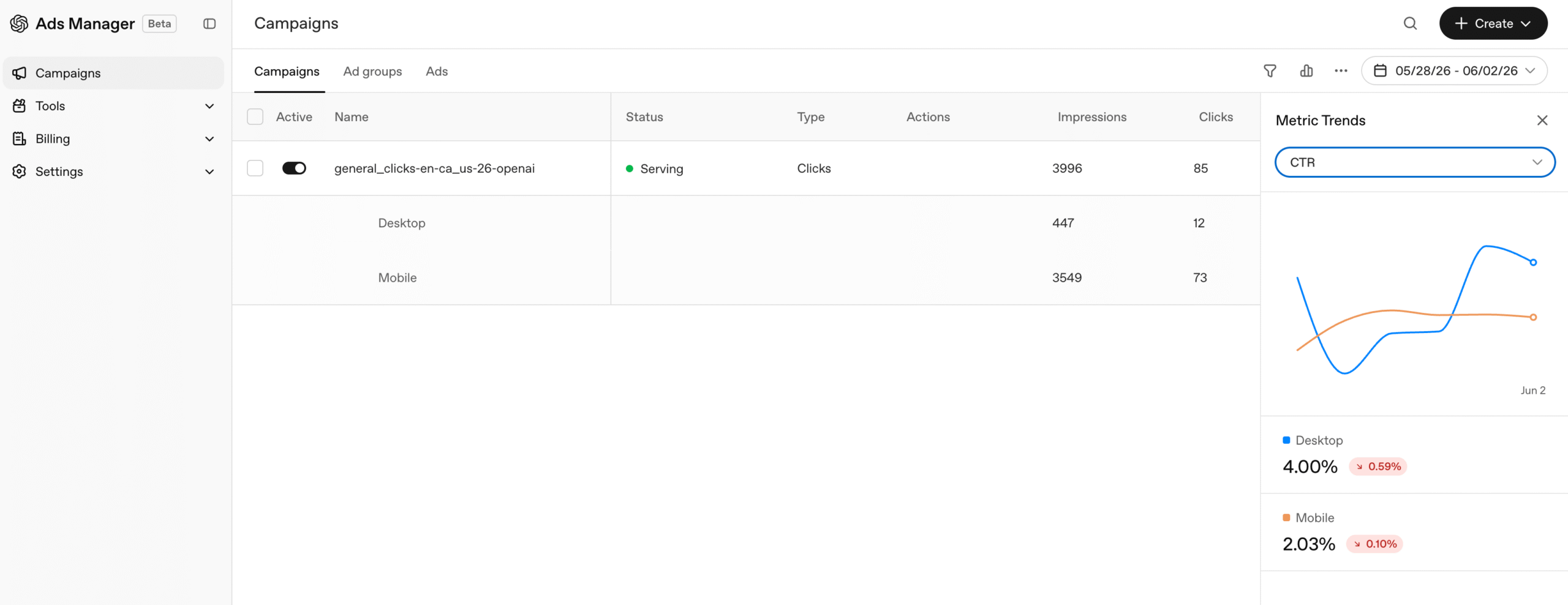
Month two is when you start seeing real CPA data. Expect your first campaigns to come in 20 to 40% above your Meta CPA. That’s fine. The audience is colder, and the platform’s optimization is younger. The question is whether the LTV of a ChatGPT-acquired customer is higher than a Meta-acquired one, and early signals from our US clients suggest it is, because the intent at the point of click is stronger.
Month three is when you decide. Either the channel is delivering profitable customers (scale it), or it isn’t (pause it and revisit in six months when targeting improves). What you do not want to do is run for 30 days, decide it’s “not working,” and quit. That’s how brands missed Meta in 2014 and Google Shopping in 2010. Both of those were “too expensive” and “not working” until suddenly they were the dominant acquisition channel.
Where most brands will get this wrong
Three mistakes I’m already seeing, less than 30 days into the platform being open:
The first is using ChatGPT ad creative that reads like a Google Search ad. ChatGPT users are in conversation mode. They want answers, not headlines. The ad copy that works looks more like a useful recommendation (“If you’re shopping for a 10-year-old who loves Lego, the Technic Liebherr crane is the sweet spot of price and build complexity”) and less like a pitch (“Best Lego Sets Under $100 – Free Shipping!”). Different format, different rhythm.
The second is sending ChatGPT traffic to a homepage. ChatGPT clicks are warm but specific. If someone clicked an ad about running shoes for flat feet, do not send them to your shoe category page. Send them to a landing page that answers the exact query and shows the exact product. The bounce-rate gap between a generic homepage and a query-matched landing page is brutal on this channel.
The third is not setting up the pixel before launching campaigns. I cannot stress this enough. If you launch ads with no conversion tracking, you will get six weeks of data showing “Total Clicks” and zero data showing what those clicks did on your site. Then you’ll pause the campaigns and tell your team “ChatGPT Ads doesn’t work.” It does work. You just didn’t measure it.
What to do Monday morning
If you’re running a Canadian e-commerce brand and you’ve read this far, here’s the order of operations:
- Audit your current ad measurement. If your Google Ads or Meta conversions are clean and your reported revenue matches your Shopify or WooCommerce reports within 5%, you’re ready for a new pixel. If they don’t match, fix that first.
- Set your test budget. $3K per month for 60 days is the floor. Less than that and you won’t learn anything statistically meaningful.
- Pick three products or services with the highest LTV in your catalog. Those go in the first campaign. Not your bestsellers, your highest-LTV items.
- Talk to Index Agency about deploying the OpenAI Ads pixel correctly the first time. We’ve already built the tooling. The 30 days you’ll save fighting broken event firing is the difference between profitable month-two campaigns and a write-off.
The brands that won Google Ads in 2008 weren’t the ones who waited until the platform was “mature.” They were the ones who set up clean tracking, made one campaign work, and had a year of compounding data before everyone else showed up. The same playbook works here.
If you want to talk through whether your business fits the channel, what budget makes sense for your category, or how to set up pixel tracking properly on your stack, that’s what we do at Index Agency. Get in touch and we’ll tell you honestly whether ChatGPT Ads is the right channel for you right now, or whether you should wait. We’d rather turn away an unfit client than burn their ad budget proving a point.
Frequently asked questions about ChatGPT Ads
What is ChatGPT Ads?
ChatGPT Ads is OpenAI’s paid advertising platform that places sponsored results inside ChatGPT conversations. Ads are clearly labeled as sponsored and matched to the topic of a user’s conversation. OpenAI launched a self-serve Ads Manager with CPC bidding in May 2026.
How much does ChatGPT Ads cost?
OpenAI recommends a starting maximum CPC bid of $3 to $5 USD per click. For a meaningful test, brands should plan a minimum monthly budget of $3,000 to $5,000 over 60 days to collect statistically valid performance data.
Is ChatGPT Ads available in Canada?
As of May 2026, OpenAI’s self-serve Ads Manager is open to US advertisers, with the pilot expanding to the UK, Mexico, Brazil, Japan, and South Korea. Canadian brands can access ChatGPT Ads through agency partners or by running US-targeted campaigns; a formal Canada opening is expected later in 2026.
How do conversions track from ChatGPT Ads?
OpenAI’s OAIQ pixel sets a first-party cookie called __oppref on the advertiser’s domain with a 30-day attribution window. The pixel records events like product views, add-to-carts, checkout starts, and purchases, then sends them to OpenAI’s Conversions API for attribution.
Should my brand test ChatGPT Ads in 2026?
Yes if you sell considered-purchase products with an AOV above $50, already run profitable Google or Meta campaigns, and can commit a $3,000+ monthly test budget for 60 days. Wait if your site has measurement gaps, you sell impulse-purchase items under $20 AOV, or you’re a local service business.